
 Share This Page
| Home | | Natural Resources | | | Share This Page |
Copyright © 2022, Paul Lutus — Message Page
Most recent chart update:
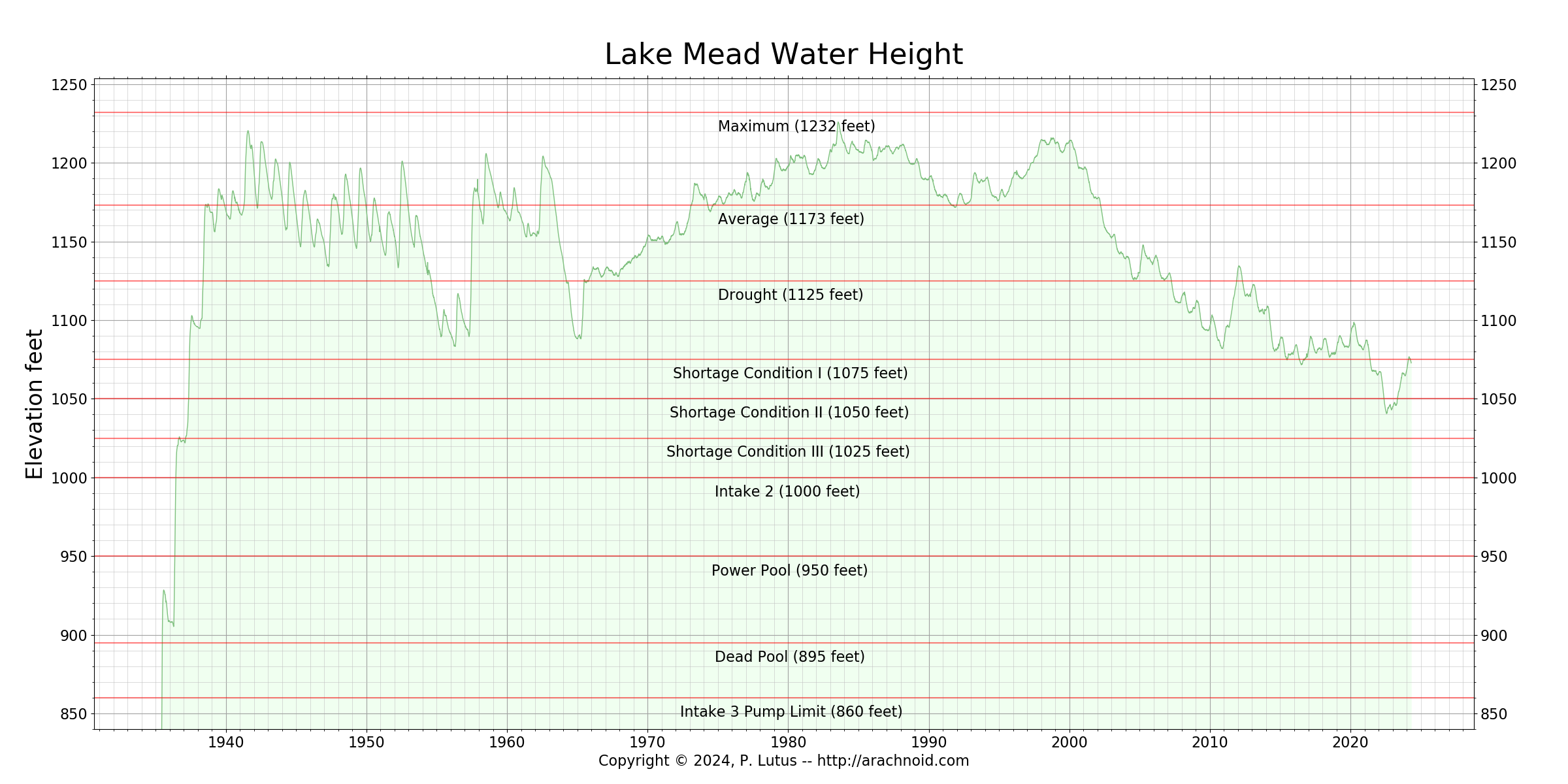
Click the chart above for a full-size version
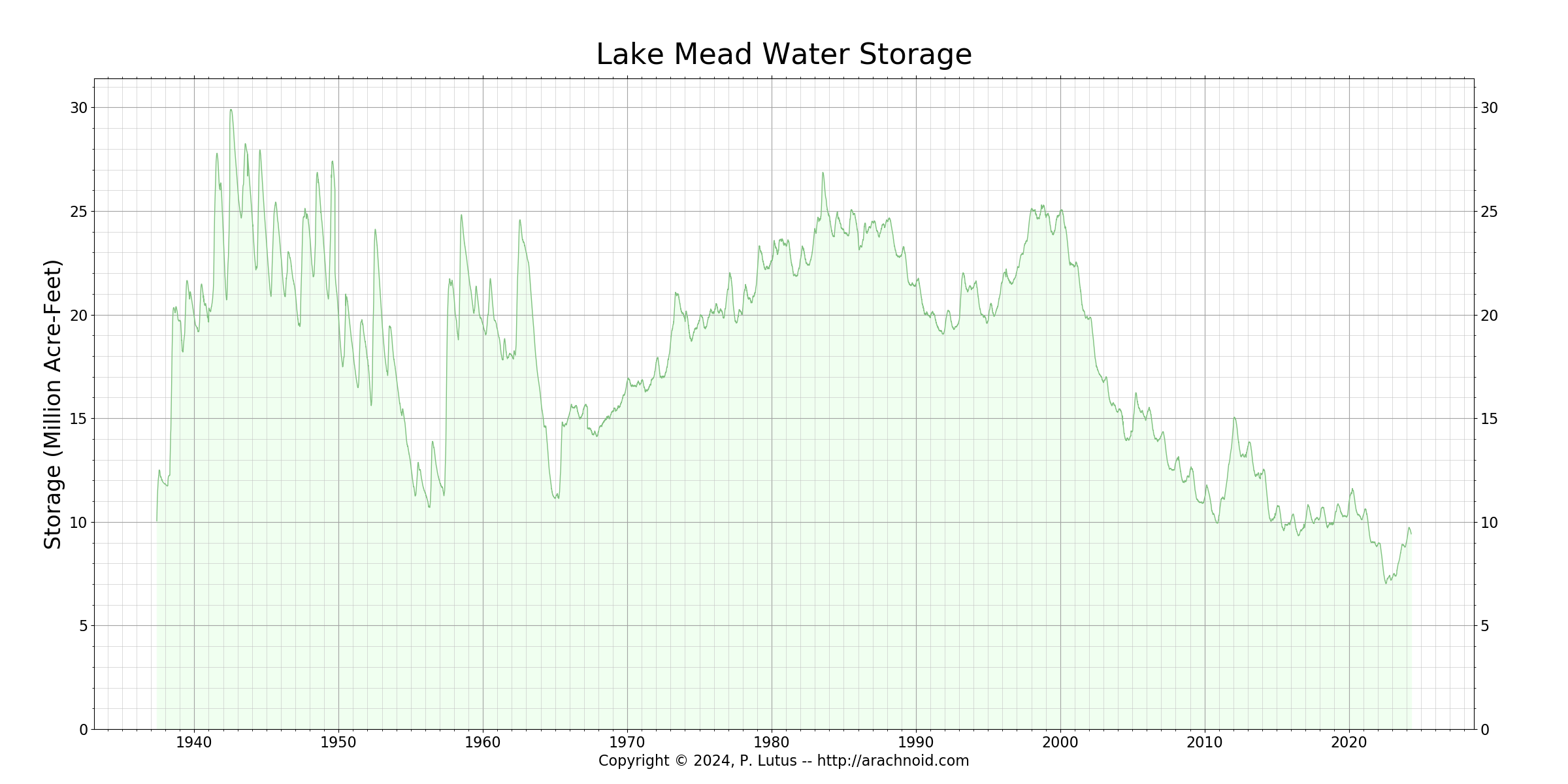
Click the chart above for a full-size version
| Term | Definition |
| Power Pool | Minimum water level that allows power generation |
| Dead Pool | Minimum water level that allows water to flow out of the reservoir |
|
These charts are dynamically updated. This page reads data from a government archive of water height/storage for Lake Mead from 1935 to the present, and draws the chart on that basis. The database, located at https://www.usbr.gov/uc/water/hydrodata/, is regularly updated. This page's graphic updates itself in step with the data source, over time giving an easy-to-interpret picture of Lake Mead water data. The chart on this page will show the Lake Mead water data until the source data page disappears or is moved, after which I will have to revise the code responsible for drawing the graphic. 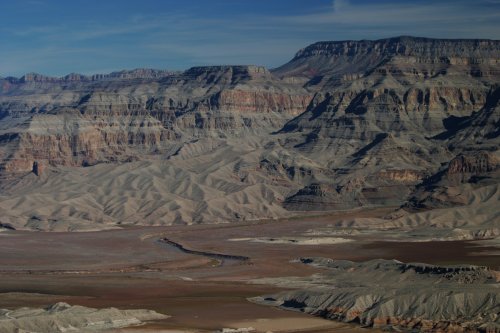
Figure 1: View of Lake Mead and the Colorado River from Pearce Ferry, January 2004 The observant reader will notice a pattern of rapidly varying water height in the Lake Mead chart above from 1935 until the mid-1960s, after which the water level became more consistent in the short term. My theory is this smoothing was caused by the fact that Lake Powell, upstream from Lake Mead, began to fill in 1966, taking 17 years to fill completely (that would take us to 1983). It is reasonable to assume the people overseeing this filling operation took more water for Lake Powell at times of rapid flow, thus smoothing out the flow peaks and troughs that were seen in Lake Mead beforehand. Since that time I would guess that Lake Powell now absorbs the annual peaks and troughs once seen in the Lake Mead data, and acts as a buffer for Lake Mead. Click this link to see the corresponding water heights in Lake Powell. Update (2010) New York Times: Water Use in Southwest Heads for a Day of Reckoning — Describes steps that will have to be taken if Lake Mead's water level drops below 1075 feet. Briefly, this critical shortage level will automatically trigger emergency measures agreed on by the seven nearby states that depend on Lake Mead's water — including rationing. Ironically, the proposed rationing measures don't include California, whose water demands get first priority. Update (2014) New York Times: Colorado River Drought Forces a Painful Reckoning for States — More detail, more concern, as Colorado river flow declines further. "The sinuous Colorado River and its slew of man-made reservoirs from the Rockies to southern Arizona are being sapped by 14 years of drought nearly unrivaled in 1,250 years." "...many experts believe the current drought is only the harbinger of a new, drier era in which the Colorado's flow will be substantially and permanently diminished." The meaning of the above chart's ration regime and pump limit labels is provided in the linked article. Update (2015) CBS News: Las Vegas uncaps Lake Mead's "third straw" for water supply — a project to decrease the lowest pumping level from 1,000 feet to 860 feet is now complete. I redesigned my chart to reflect this change. |
| Home | | Natural Resources | | | Share This Page |